Why Babar Azam is Struggling in T20 Cricket (2026 Updated)
"Is the King losing his crown? In this deep-dive analysis, we break down why Babar Azam is struggling in T20 cricket in 2026. From strike rate concerns to technical flaws against spin and the pressure of captaincy, we explore the stats and facts behind the slump. Read the full 2026 T20 World Cup post-mortem here
Huzaifa Ahmad
3/23/20264 min read
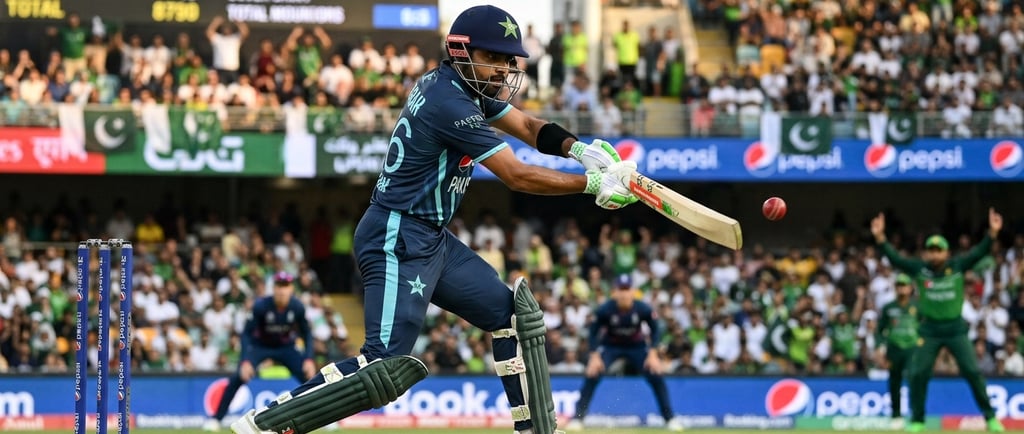
The Fall of a King? Why Babar Azam is Struggling in T20 Cricket (2026 Analysis)
In the world of cricket, few names carry as much weight as Babar Azam. For years, he was the undisputed anchor of the Pakistan national team, a player whose cover drive was likened to poetry in motion. However, as we move through the early months of 2026, the narrative has shifted. From being the world’s No. 1 T20I batter, Babar has seen a significant dip in his rankings, his impact, and his reputation as a "match-winner" in the shortest format.
Following a difficult BBL 2025–26 stint and a highly scrutinized T20 World Cup 2026 campaign, the question is no longer if he is struggling, but why. In this 2,000-word deep dive, we break down the five core reasons behind Babar Azam’s T20 decline.
1. The Strike Rate Paradox: A Modern Game vs. A Classic Technique
The most glaring issue in Babar Azam’s T20 game is his strike rate. In an era where "Strike Rate is King," Babar’s approach remains rooted in the classic "anchor" role.
The Powerplay Stagnation
Statistics from the T20 World Cup 2026 revealed a startling trend: Babar Azam’s strike rate in the Powerplay (the first 6 overs) has hovered below 90. In modern T20 cricket, where teams look to exploit the fielding restrictions to score at 9 or 10 runs per over, Babar’s tendency to play out dot balls creates immense pressure.
* The "Dot Ball" Pressure: Analysts note that Babar often consumes 20–25 balls to reach a score of 20. While he rarely gets out early, his inability to rotate strike against high-quality pace early on forces his opening partner (often Mohammad Rizwan or Saim Ayub) to take unnecessary risks.
* Passing the Burden: When Babar occupies the crease without accelerating, the required run rate climbs. By the time the middle order walks in, they are facing a required rate of 12+, leading to the "collapse" that has become synonymous with Pakistan's T20 batting.
2. Technical Vulnerabilities: The Spin Trap and the Moving Ball
For much of his career, Babar was considered technically flawless. However, recent series in 2025 and 2026 have exposed specific chinks in his armor.
The Leg-Spin Nightmare
High-quality leg-spin has become Babar’s "Achilles' heel." Whether it’s England’s Adil Rashid or Australia’s Adam Zampa, spinners have successfully dried up Babar’s scoring options.
* The Googly Factor: Babar has shown a recurring struggle in picking the googly, often leading to LBW shouts or mistimed chips to mid-wicket.
* The Lack of Power-Hitting: Unlike contemporary T20 greats like Suryakumar Yadav or Heinrich Klaasen, Babar lacks the "360-degree" game. He relies heavily on traditional cricketing shots. When captains set a deep mid-wicket and a long-on, Babar often finds himself unable to clear the boundary, leading to a mounting dot-ball count.
The Left-Arm Angle
The left-arm pace angle (over the wicket) continues to trouble him. Bowlers like Mitchell Starc and Shaheen Afridi (in domestic circuits) have exploited his tendency to play across the line early in his innings, leading to early dismissals that were rare three years ago.
3. Tactical Mismanagement: The No. 4 Experiment
One of the biggest talking points of the 2026 T20 World Cup was the decision by head coach Mike Hesson to move Babar Azam to No. 4.
* Identity Crisis: Babar is a rhythmic player who needs the pace of the new ball to find his timing. Moving him to the middle order meant he was walking out when spinners were operating with spread-out fields.
* The Failure to Adapt: At No. 4, the demand is for immediate acceleration. Babar’s natural instinct is to "settle in." This clash of styles meant he was neither an anchor nor a finisher, leaving him in a tactical "no man's land."
4. The Mental Weight: Captaincy and Public Scrutiny
It is impossible to separate Babar the batter from Babar the (former) captain. The constant "musical chairs" of leadership in Pakistan cricket has clearly taken a toll on his mental focus.
The Burden of Expectations
In Pakistan, Babar is expected to be Virat Kohli, Kane Williamson, and Joe Root all at once. Every failure is magnified ten-fold on social media.
The "Coterie" Allegations: Reports of dressing room divisions and the "friendship group" (often termed Yari Dosti in local media) have added external pressure.
Loss of Confidence: During the PSL 2025 and 2026 seasons, observers noted a change in Babar's body language. The swagger of 2021 has been replaced by a visible tentativeness. Even his signature cover drive, once a certain boundary, is now often found by the extra-cover fielder.
5. Fitness and Modern Athleticism
A controversial but necessary point of discussion is Babar’s physical evolution. In the high-octane environment of T20 cricket, fitness isn't just about stamina; it's about explosive power.
Running Between the Wickets: In 2026, critics like Ahmed Shehzad pointed out that Babar’s speed between the wickets has plateaued. T20 games are often won by turning ones into twos, a department where Babar has lagged behind younger, more athletic counterparts.
Power Generation: Modern T20 batting requires immense core strength to clear long boundaries even on mis-hits. Babar’s reliance on "timing" means that if his timing is off by even a fraction, he fails to clear the rope.
Comparison: Babar Azam T20 Stats (2021 vs. 2026)
| Year | Average | Strike Rate | 50+ Scores |
| 2021 (Peak) | 45.2 | 136.5 | 9 |
| 2026 (Current) | 22.8 | 112.4 | 2 |
Data reflects combined International and Franchise (BBL/PSL) T20s.
The Way Forward: How Can Babar Reclaim His Throne?
Babar Azam is only 31 years old. He is far from "finished," but he is at a crossroads. To survive in T20 cricket, he must evolve:
* Embrace a New Role: He must decide if he wants to be a specialist Test/ODI player or a T20 innovator. If it’s the latter, a stint in minor leagues or specialized power-hitting camps is essential.
* Focus on Strike Rotation: The "boundary or dot" mentality must change. Developing a reliable sweep shot or a late cut against spin would relieve the pressure he feels.
* Mental Reset: Stepping away from the T20 format for a few months to focus on domestic red-ball cricket might help him find his "lost" timing.
Final Verdict
Babar Azam remains a world-class talent, but the T20 format has outgrown the version of Babar we saw in 2021. For Pak Sports fans, the hope is that this "lean patch" is merely a transition toward a more aggressive, 2.0 version
Contact
Questions or feedback? Reach out anytime.
© 2026. All rights reserved.