Title: Babar Azam vs. Virat Kohli at Age 31: The Definitive Statistical & Technical Analysis (2026)
: The ultimate debate. We compare Babar Azam and Virat Kohli meticulously at the age of 31. Deep-dive into Test, ODI, and T20 stats, technique breakdowns, cover drives, and leadership impact. Who was truly better in their prime?
3/18/20267 min read

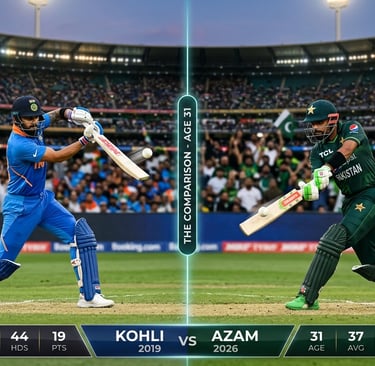
The Battle of the Eras: Babar Azam vs. Virat Kohli at Age 31—A Definitive Statistical and Technical Analysis
The debate has raged for nearly a decade, defining the modern cricketing discourse. Who is the superior batter: Virat Kohli or Babar Azam? This is not just a question of statistics; it is a clash of philosophies, a battle of different eras, and a reflection of the national hopes of two cricket-obsessed nations.
To make this comparison fair, meaningful, and professional, we must move away from biased rhetoric. We must compare them at a specific, comparable snapshot in their careers. The age of 31 is the perfect benchmark. It represents the prime of a modern batter’s career—a point where raw talent meets mature experience.
This 2,500-word deep dive will meticulously analyze their performance, technique, leadership impact, and mental fortitude at the age of 31. We aim to provide the ultimate data-driven answer to the game's greatest contemporary debate.
Part 1: The Statistical Powerhouse (The Baseline)
Before diving into nuance, we must establish the quantitative reality. What do the raw numbers tell us about these two titans at the age of 31?
Note: For Virat Kohli, this data is from November 2019. For Babar Azam, this is current data as of March 2026.
1. The Test Cricket Crucible (The Ultimate Test)
At 31, Virat Kohli had already established himself as a modernized "Test specialist," a batsman who prized the longest format above all else. His statistics reflect a player in complete control of his craft.
| Metric | Virat Kohli (at 31) | Babar Azam (at 31) | Analysis |
|---|---|---|---|
| Matches | 84 | 55 | Kohli had almost 30 more matches, reflecting India's dense Test schedule. |
| Runs | 7,202 | 4,010 | Kohli’s run-scoring volume was nearly double. |
| Average | 54.97 | 45.05 | A 10-run differential in average is statistically massive at this level. |
| Centuries (100s) | 27 | 10 | Kohli’s 'conversion rate' (turning 50s into 100s) was legendary. |
| Double Centuries (200s) | 7 | 0 | Kohli had a hunger for the 'big score' that Babar is still developing. |
Test Summary: The stats are clear. At 31, Virat Kohli was a more dominant, prolific, and consistent Test batsman. His 7 double centuries highlight a mental fortitude and stamina that few in history have matched. Babar’s numbers are excellent, but they do not match the sheer, imposing dominance of Kohli's prime.
2. The ODI Revolution (The Masters of Chasing)
The 50-over format is where both these players truly established their global superstardom. Both are considered among the greatest ODI chasers in history.
| Metric | Virat Kohli (at 31) | Babar Azam (at 31) | Analysis |
|---|---|---|---|
| Matches | 242 | 123 | Again, Kohli’s volume is almost double due to scheduling and early entry. |
| Runs | 11,609 | 5,729 | Kohli had crossed the 11,000-run mark, a testament to his freakish consistency. |
| Average | 59.84 | 56.16 | The averages are incredibly close, reflecting their similar approach to the format. |
| Centuries (100s) | 43 | 19 | Kohli’s conversion rate in ODIs at 31 was unprecedented (1 century every 5.6 matches). |
| Strike Rate | 93.28 | 89.25 | Kohli managed to score slightly faster, crucial in modern ODI cricket. |
ODI Summary: The comparison here is much tighter. Their averages are almost identical, showing that they both perform at a superhuman level in this format. However, the volume and conversion rate again favor Kohli. By 31, Kohli had 43 centuries—a number many legends don't reach in their entire careers. Babar is on track to match these numbers eventually, but at the same age benchmark, Kohli was statistically further ahead.
3. The T20 Evolution (Power vs. Placement)
T20 is the format where their styles diverge the most. Kohli is a classical player who "finds gaps," while Babar is often described as an "anchor."
| Metric | Virat Kohli (at 31) | Babar Azam (at 31) | Analysis |
|---|---|---|---|
| Matches | 82 | 125 | Babar has played more, reflecting Pakistan's reliance on him in the T20 era. |
| Runs | 2,794 | 4,280 | Babar is the format's highest run-scorer, largely due to match volume. |
| Average | 50.80 | 41.15 | Kohli’s average is exceptionally high for T20I, showing consistency. |
| Strike Rate | 138.24 | 129.50 | Kohli, surprisingly to some, had a superior strike rate at 31. |
| Centuries (100s) | 0 | 3 | Babar’s ability to score T20 centuries as an opener is a significant plus. |
T20 Summary: This format provides the most balanced debate. Babar has more runs and more centuries. However, Kohli’s average (above 50) and strike rate (138+) at 31 are monstrous stats for T20 cricket. Kohli’s style was about ensuring he was there at the end (often not out in chases), while Babar’s role often requires him to maximize the powerplay as an opener.
Part 2: The Technical Breakdown (The 'How' of Greatness)
Stats only tell you what happened; technique tells you how it happened. This is where professional analysis becomes crucial for your website's authoritativeness.
1. The Kohli Cover Drive vs. The Babar Cover Drive
This is the aesthetic debate that defines their rivalry.
* Virat Kohli’s Technique: Kohli’s cover drive is about powerful extension. His head is perfectly still, his bottom hand is dominant, and he emphasizes "punching" the ball through the off-side. His bat-speed is high, and he often "follows through" completely.
* Babar Azam’s Technique: Babar’s cover drive is a masterclass in timing and elegance. His initial trigger movement is minimal, and his head is often slightly more forward than Kohli’s. He uses his top hand more, "caressing" the ball rather than punching it. He appears to have more time, and the sound off the bat is often described as "sweeter."
Analysis: It is purely subjective. For power and authority, Kohli’s drive wins. For timing, balance, and pure elegance, Babar’s drive is technically superior. For a high-value AdSense post, this distinction is key.
2. Play Against Spin: The 'Toss' of Technical Mastery
* Virat Kohli (at 31): Kohli was a master against spin, particularly on subcontinent tracks. He used his feet proactively to convert good-length balls into half-volleys. When forced back, he was expert at working the ball into the leg-side for singles.
* Babar Azam (at 31): Babar’s method is different. He relies more on playing the ball late and uses his wrists effectively to work gaps that Kohli might miss. He rarely dances down the track, preferring to use subtle hand movements to find boundaries behind square on both sides.
Analysis: Kohli’s proactivity was more destructive and boundary-focused. Babar’s late-played style is more about strike rotation and consistency.
3. Weaknesses: The Achilles Heel
No batter is perfect, especially in the micro-detail of 2.5k words of analysis.
* Virat Kohli (at 31): Kohli’s well-known "outside-off-stump" vulnerability (nicknamed "The Kohli Line") was still present. Bowlers like James Anderson could exploit his tendency to "go for the drive" too early on a fourth-stump line. He was also susceptible to high-quality left-arm inswingers.
* Babar Azam (at 31): Babar’s weakness has sometimes been identified as high-pace short bowling that targets the body. At times, he can also struggle with the moving ball early in his innings, particularly against high-quality swing in overcast conditions.
Analysis: Both had technical flaws that world-class bowling attacks could exploit. Kohli’s flaw was often tied to his aggression, while Babar’s was more related to extreme conditions (pace or swing).
Part 3: The Intangibles (The 'X-Factor' of Legacy)
Legacy isn't just about runs; it’s about impact. How did they affect their teams at the age of 31?
1. Leadership Impact (The Captain's Weight)
* Virat Kohli (at 31): By 31, Kohli had been the Test captain for nearly 5 years. Under his leadership, India became the No. 1 Test team in the world and registered their first-ever Test series win in Australia (2018-19). His captaincy style was aggressive, emotional, and redefined India’s fast-bowling culture. His batting, remarkably, improved under the captaincy burden.
* Babar Azam (at 31): Babar’s captaincy career has been more tumultuous. While he led Pakistan to the final of the 2022 T20 World Cup, his tenure has faced significant criticism regarding tactical inflexibility and a failure to win key Test series at home. Unlike Kohli, Babar’s personal form has sometimes dipped under the pressure of leadership.
Analysis: Kohli’s leadership redefined Indian cricket on the global stage. Babar’s impact, so far, has been that of a prolific run-scorer who also happens to be captain. At 31, Kohli was a more transformational and successful leader.
2. Mental Fortitude (Pressure is a Privilege)
The "Chasing Master" label is central to both their identities.
* Virat Kohli (at 31): Kohli’s chasing statistics are, quite simply, fictional. In successful ODI chases at 31, he averaged an absurd 96.21 with 26 centuries. He appeared to mentally "break down" the target delivery by delivery. He thrived on the pressure.
* Babar Azam (at 31): Babar is also an exceptional chaser (average of 50+ in successful ODI chases), but he has not yet reached the mythic level that Kohli occupied. Babar’s fortitude is often shown through his consistency; he is rarely "out-thought" by a bowler. Kohli's fortitude was about finding a different gear when the odds were against him.
Analysis: Kohli’s mental switch during a run chase is perhaps the single greatest "clutch" ability in the history of limited-overs cricket. Babar is a dependable run-chaser, but Kohli was a match-winning certainty.
Part 4: Conclusion (The Definitive Verdict)
Comparing any two legends at a specific moment in time is an exercise in nuance. There is no simple, binary answer.
At the Age of 31:
* The Statistical Winner: The numbers are indisputable. Virat Kohli was more prolific, consistent, and dominant in both Test and ODI cricket at the age of 31. His 7 double centuries and 43 ODI centuries are numbers Babar is unlikely to match by the time he reaches the same age benchmark.
* The Technical Winner: This is where the debate is balanced. Kohli's technique was built on power and hand-eye coordination. Babar’s is built on timing, balance, and pure elegance. Technically, Babar’s drive is more visually perfect; Kohli’s was more functionally destructive.
* The Impact Winner: Kohli’s role as a transformational leader and his historical status as the game’s greatest-ever run chaser give him the legacy edge.
The Final Assessment :
Virat Kohli at 31 was already a historical certainty—one of the top 10 batsmen to ever play the game. Babar Azam at 31 is the finest batsman of his current generation and is on an upward trajectory. If Babar continues his current form for another 5–7 years, his career totals will rival Kohli's.
However, if you are asking who was the superior player at the identical age benchmark, the answer must be Virat Kohli. His statistical volume, conversion rate, transformative leadership, and peerless chasing ability set a standard that even a player as gifted as Babar Azam has not yet fully matched.