The Wankhede Mind Games: Harry Brook’s Strategic Defiance Ahead of the India Semifinal
In a press conference that felt more like a psychological opening spell than a media obligation, England captain Harry Brook set the stage for the 2026 T20 World Cup semifinal at the Wankhede Stadium. Facing the press on March 3, 2026, Brook presented a version of England that is comfortable with chaos, dismissive of critics, and—most importantly—eager to play the "villain" in Mumbai.
MATCH UPDATES
3/4/20264 min read
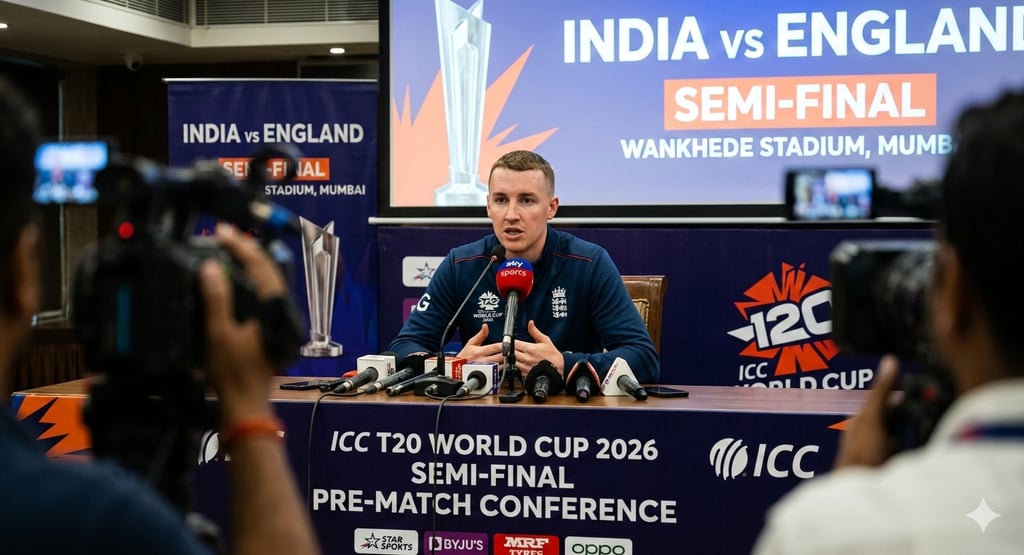
The atmosphere surrounding the 2026 T20 World Cup semifinal between India and England has reached a fever pitch, but perhaps no individual has captured the essence of the moment better than England’s captain, Harry Brook. His pre-match press conference at the Wankhede Stadium was a masterclass in modern sports psychology—a blend of Yorkshire grit, tactical defiance, and a subtle "underdog" narrative designed to deflect pressure from his own camp and firmly onto the shoulders of the home nation.
At only 27, Brook is no longer just the "prodigy" of English cricket; he is the architect of their aggressive identity. His analysis of the upcoming clash reveals a team that isn’t just prepared for a cricket match, but for a psychological war in one of the world's most hostile sporting environments.
1. The Power of "Scraping Through"
One of the most revealing moments of the conference was Brook’s rebuttal to the narrative that England’s path to the semifinals was "shaky." England had a rollercoaster Super 8 stage, including a narrow win where they were arguably outplayed for 35 of the 40 overs.
Instead of apologizing for the lack of clinical dominance, Brook leaned into it.
> "We have been in positions where we were dead and buried. We’ve scraped through games that we had no right to win. That builds a different kind of muscle memory than just blowing teams away. We know how to survive."
>
Analysis: This is a calculated message to the Indian dressing room. Brook is signaling that England is "un-killable." In knockout cricket, the team that panics last usually wins. By highlighting their ability to win "ugly," Brook is telling India that even if they take early wickets or dry up the runs, England won't crumble. This rebrand of "inconsistency" into "resilience" is a classic tactical pivot.
2. The Cult of the Top Seven
The biggest question mark for England has been the form of their legendary opening pair, Jos Buttler and Phil Salt. With Buttler averaging under 10 in the tournament, the English media was looking for a sign of a tactical shift—perhaps moving Brook himself to open.
Brook shut this down with startling conviction. He described his top seven as a "lineup of match-winners" where individual averages are irrelevant.
* The "One Man" Theory: Brook argued that England doesn't need all eleven players to fire. If just one of the top seven bats through 15 overs, they will post 200+.
* The Fear Factor: By publicly backing Buttler, Brook is reminding India of the damage a "due" world-class player can do. It forces the Indian analysts to spend more time worrying about a struggling player’s potential than focusing on the players currently in form.
3. Dealing with the "Wankhede Cauldron"
Playing India in India is a unique challenge; playing them in a World Cup semifinal at the Wankhede is a different beast entirely. Brook was asked repeatedly about the noise, the heat, and the 33,000 fans who will be draped in blue.
His response was both witty and grounded:
> "I’m not sure there are going to be many people behind us tomorrow. We’re essentially the villains in this movie, aren't we? But we like that. It’s easier to play when everyone expects you to lose."
>
Tactical Nuance: Brook is attempting to transfer the "Weight of Expectations." India, playing at home, carries the dreams of 1.4 billion people. England, the defending champions but perceived underdogs in these conditions, have nothing to lose. By embracing the "villain" role, Brook is giving his team a psychological shield—they can play with the freedom of a team that has already been counted out by the local crowd.
4. The Technical Battle: Pace vs. Spin
Brook’s own form has been the silver lining of England’s campaign. Having moved to the No. 3 spot, he has transitioned from a "finisher" to the "engine room" of the innings. He addressed the specific challenge of facing India's spin twins, Varun Chakaravarthy and Ravi Bishnoi, on a pitch that might offer turn.
The "Step-Out" Strategy
Brook hinted that England would not allow the spinners to settle into a rhythm. His philosophy is simple: Disturb the length.
* He spoke about using the crease—going deep to play the pull and stepping out to negate the turn.
* He referenced his recent 50-ball century against Pakistan as a template for how he intends to dominate the middle overs.
Respecting Bumrah
In a moment of candor, Brook admitted that Jasprit Bumrah is "the best in the world." However, he added a cheeky rider: "Even the best bowlers have bad days if you put them under enough pressure in the first six." This suggests England will not "respect" Bumrah’s reputation; they will try to take him down early to disrupt India’s entire bowling blueprint.
5. The "McCullum Effect" and New Leadership
This was Brook’s first major pre-semifinal presser as the undisputed leader of the T20 side. The influence of Brendon "Baz" McCullum was evident in every sentence. There was no mention of "playing safe" or "assessing the conditions." The mantra was total aggression.
Brook mentioned that the team’s internal metrics don’t look at "dot balls" as much as they look at "intent." If a player gets out caught on the boundary trying to hit a six, Brook sees that as a win for the team’s culture, even if it’s a loss on the scorecard. This "no-consequences" leadership style is designed to liberate his players in a high-pressure semifinal.
6. Comparison: India’s Pressure vs. England’s Momentum
Brook concluded the conference by comparing the two camps. He noted that India has played "perfect" cricket so far, while England has played "scrappy" cricket.
| Feature | India (According to Brook) | England (According to Brook) |
|---|---|---|
| Current Form | Flawless / Peak | Building / Momentum |
| Pressure | National Expectation | "Nothing to Lose" |
| Crowd | 12th Man | Fuel for the "Villain" Narrative |
| Tactics | Balanced / Traditional | High-Risk / High-Reward |
> The Conclusion: Brook’s final takeaway was that "Perfect teams are the ones most scared of losing." It was a parting shot aimed at making the Indian team second-guess their own dominance.
>
Final Thoughts
Harry Brook’s conference wasn't just a media obligation; it was the first ball of the semifinal. By defending his openers, embracing the hostile crowd, and reframing England’s struggles as "resilience," he has positioned his team as a dangerous, unpredictable threat. He has effectively told the world: India might be the better team on paper, but England is the team you don't want to meet in a dark alley (or a Wankhede semifinal).

Contact
Questions or feedback? Reach out anytime.
© 2026. All rights reserved.