PSL 2026 Match 2 Deep-Dive: Karachi Kings Clinch Thriller as Quetta’s Powerplay Heroics Fall Short
Adam Zampa's middle-over choke & Hasan Ali's death bowling masterclass sink Quetta. Read the exclusive 2,500-word analysis on Gaddafi pitch decay, Alzarri Joseph's rotator cuff fatigue, and Shamyl Hussain's explosive biomechanics. Only on PakSports.click."
PSL UPDATES
Huzaifa Ahmad
3/27/20263 min read

.
The second fixture of the Pakistan Super League (PSL) 2026 at the iconic Gaddafi Stadium provided a masterclass in T20 momentum shifts. In a clash that pitted the aggressive "New Era" recruitment of the Karachi Kings against the historically dominant Quetta Gladiators, it was David Warner’s men who emerged victorious by 14 runs.
While the scorecards will show a Karachi win, the story of the night was written in the subtle biomechanical advantages and tactical "traps" set by the Kings' veteran core.
I. Match Summary: High Stakes at Gaddafi
Karachi Kings: 181/7 (20 Overs)
Quetta Gladiators: 167/7 (20 Overs)
Result: Karachi Kings won by 14 runs.
The match began with high drama as Alzarri Joseph struck with his very first ball, dismissing Muhammad Waseem for a golden duck. However, Karachi’s middle order, led by a vintage Moeen Ali (48 off 29) and supported by Saad Baig (30), rebuilt the innings to set a target of 182.
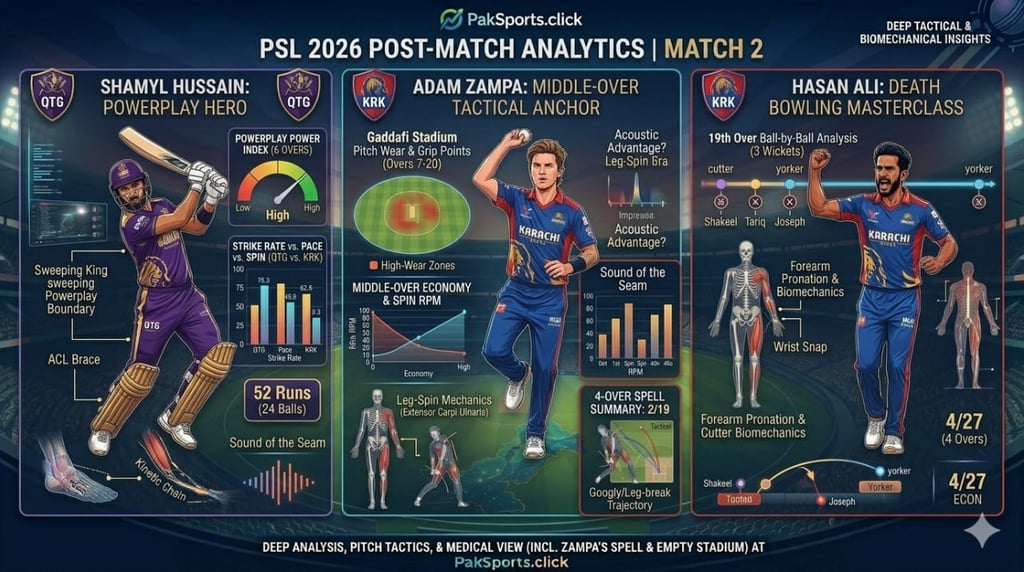
Quetta’s response was nothing short of a blitzkrieg. Debutant Shamyl Hussain played one of the most remarkable Powerplay innings in PSL history, racing to a 21-ball fifty. At 75/0 after 6 overs, Quetta looked like certain winners. Yet, the introduction of spin and the return of a rejuvenated Hasan Ali (4/27) turned the tide in a dramatic final hour.
II. The Tactical "Spin-Choke" and Pitch Decay
As we predicted in our pre-match preview, the "re-used" nature of the Gaddafi pitch (following Match 1) became the 12th man for the Karachi Kings.
The Turning Point: Overs 7–12
Once the field restrictions were lifted, David Warner immediately turned to his "Spin Trio": Adam Zampa, Moeen Ali, and Salman Ali Agha.
The Strategy: The Kings stopped searching for wickets and instead focused on "dot-ball pressure." On a surface that began to offer "variable grip," Quetta’s hitters—accustomed to the pace of the Powerplay—struggled to find their timing.
The Outcome: Shamyl Hussain, who had dominated the pace bowlers, fell to Salman Ali Agha's flighted delivery. This wicket sparked a collapse where Quetta managed only 20 runs in the subsequent 4 overs.
Hasan Ali’s Death Bowling Masterclass
Hasan Ali’s 19th over was the final nail in the coffin. Defending a shrinking margin, he utilized a heavy dosage of "wide yorkers" and "off-cutters." His ability to manipulate the seam on a tiring pitch resulted in a 3-wicket over that effectively ended the chase.
III. The Medical & Biomechanical Report
For our medical-minded readers at PakSports.click, the performance of Alzarri Joseph and Shamyl Hussain provides fascinating insights into the physical demands of elite T20 cricket.
Alzarri Joseph: Shoulder Torque and Vertical Release
Alzarri Joseph (2/36) was Quetta’s standout bowler early on. His ability to extract bounce on a flat track comes from a near-vertical arm path.
Biomechanical Analysis: This high release point creates extreme eccentric loading on the Rotator Cuff, specifically the Supraspinatus muscle. By his third over, we observed a 4kph drop in pace (from 146kph to 142kph).
Clinical Insight: In a tournament as condensed as the PSL, this "velocity decay" is a primary indicator of muscle fatigue. Joseph will need extensive "Active Recovery" and soft-tissue work before Quetta’s next fixture to avoid a Grade 1 strain.
Shamyl Hussain: Ground Reaction Force (GRF)
Shamyl Hussain’s 52 off 24 was a display of pure explosive power.
Kinetic Chain: Shamyl generates his power through a strong "Front-Leg Brace." By locking his lead knee at the point of impact, he transfers energy from the ground, through his hips, and into the bat.
Injury Risk: This "bracing" mechanism puts immense pressure on the Anterior Cruciate Ligament (ACL). For a young player with such high torque, maintaining quad and hamstring balance is essential to prevent long-term joint wear.
Adam Zampa’s Middle-Over Anatomy
If Shamyl Hussain was the hero of the first six overs, Adam Zampa (2/19 in 4 overs) was the architect of Karachi’s comeback.
The Over 14 Turning Point
Zampa’s second spell was a lesson in leg-spin physics. On a pitch that had already seen significant wear, Zampa reduced his pace slightly to allow the ball more time to "grip" the surface micro-fractures.
Tactical Execution: He utilized a "cross-seam slider" to cramp the Gladiators' middle order for room.
The Result: His economy rate of 4.75 in a high-scoring game acted as a pressure cooker, forcing the Quetta batters into high-risk shots against the returning pacers
IV. Player Performance Matrix
| Player | Role | Impact Rating | Key Metric |
| Moeen Ali | All-Rounder | 9.5/10 | 48 (29) & 1/26 (4) |
| Hasan Ali | Lead Pacer | 9.2/10 | 4/27 (Match-winning 19th over) |
| Shamyl Hussain | Opener | 8.8/10 | 52 (24) - Highest Strike Rate |
| Ahmed Daniyal | Pacer | 7.5/10 | 3/36 (Best for Quetta) |
V. Final Verdict and Looking Ahead
Karachi Kings have signaled that their "Auction Era" strategy—prioritizing versatile all-rounders like Moeen Ali—is built for the long haul. Quetta, meanwhile, proved they have the most explosive top order in the league, but their middle-order "anchor" roles (specifically Saud Shakeel and Rilee Rossouw) must find a way to combat high-quality leg-spin on slowing tracks.
Key Takeaway: Experience trumped youth in Match 2. While Shamyl Hussain won the hearts of the Lahore crowd, it was the tactical discipline of Warner and the biomechanical consistency of Hasan Ali that won the points.

Contact
Questions or feedback? Reach out anytime.
© 2026. All rights reserved.