Pakistan vs Bangladesh 3rd ODI Analysis: Agha’s Century, Bangladesh’s Series Win
A deep-dive analysis into the 3rd ODI between Pakistan and Bangladesh. Salman Ali Agha's century, Tanzid Hasan's masterclass, and a tactical breakdown of why Bangladesh won the series 2-1.
3/15/20263 min read
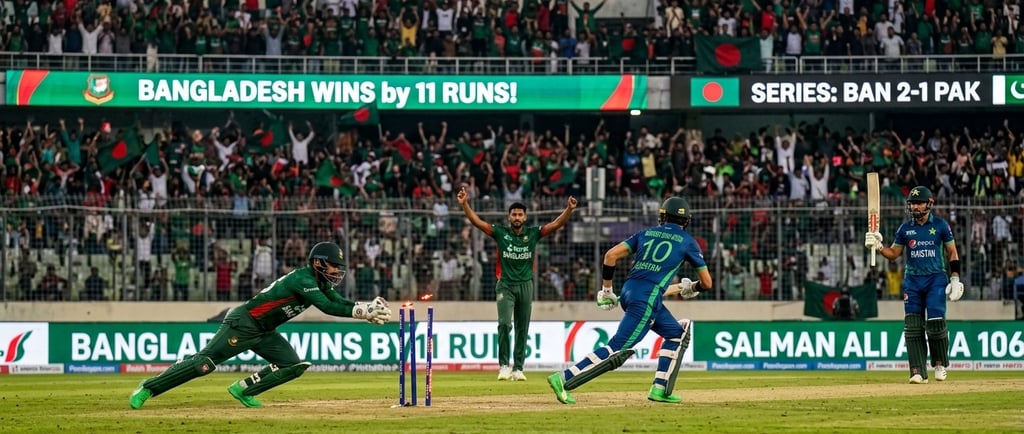
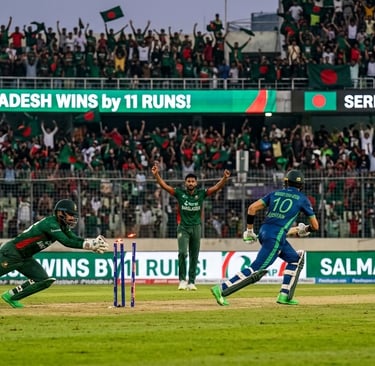
Heartbreak in Dhaka: Agha’s Fighting Ton in Vain as Bangladesh Seal Series 2-1
In a match that perfectly encapsulated the "mercurial" nature of Pakistan cricket, the third and final ODI at the Sher-e-Bangla National Stadium on March 15, 2026, ended in a pulse-pounding 11-run victory for Bangladesh. While the headlines will focus on the Tigers lifting the trophy, the narrative of the match was a grueling tactical battle that saw Salman Ali Agha emerge as a solitary hero in a middle-order collapse.
The Toss and Strategy: A Calculated Gamble?
Shaheen Shah Afridi won the toss and elected to field first—a decision influenced by the potential for dew later in the evening. On the Mirpur track, which historically offers grip for spinners as the game progresses, Pakistan’s strategy was clear: jolt the Bangladesh top order with pace and chase under the lights.
However, the Bangladesh openers, Tanzid Hasan and Saif Hassan, had other plans. Their 105-run opening stand didn't just provide a platform; it forced Pakistan out of their attacking lengths. Tanzid Hasan, in particular, played a career-defining knock of 107 off 107 balls, proving why he is one of the premier emerging talents in the subcontinent.
First Innings Breakdown: Bangladesh’s Batting Masterclass
Bangladesh’s total of 290/5 was built on three pillars:
* Top-Order Intent: Tanzid Hasan’s maiden ODI century was a masterclass in rotation. He negated the threat of Shaheen Afridi by playing late and utilizing the square of the wicket.
* Middle-Order Consolidation: Najmul Hossain Shanto’s 107 (matching Tanzid’s score) was the backbone of the middle overs. His seven sixes showcased a newfound aggression that left Pakistan's spinners, including Abrar Ahmed, struggling for rhythm.
The Late Surge: Litton Das (41) and Towhid Hridoy (48) added crucial runs in the death overs. Haris Rauf was the pick of the bowlers with 3/52, but his efforts were neutralized by a lack of support from the other end during the final 10-over block.
The Chase: A Nightmare Start and a Heroic Stand
Pakistan’s pursuit of 291 began in disastrous fashion. The top order, which has been under scrutiny throughout this tour, crumbled under the sheer pace of Nahid Rana and the disciplined lines of Taskin Ahmed.
At 17/3, and later 82/5, the match looked like a one-sided affair. Mohammad Rizwan’s early departure for 10 was a significant blow to the stability of the innings. It was here that Salman Ali Agha stepped onto the stage.
Salman Ali Agha: The Lone Warrior
Agha’s innings of 106 off 98 balls was a blend of grit and tactical genius. He recognized early that the pitch was slowing down, making horizontal bat shots risky. His sweep shots (as seen in the viral match photos) were his primary weapon, allowing him to disrupt the lengths of Mehidy Hasan Miraz and Rishad Hossain.
He forged vital partnerships:
* 79 runs with Saad Masood (38) to stabilize the ship.
* 52 runs with Shaheen Afridi (37) to bring the target within reach.
The Final Over Drama: 14 to Get
The game reached its boiling point in the 50th over. With Agha dismissed in the 48th over by Taskin Ahmed, the responsibility fell on the captain, Shaheen Afridi.
Needing 14 runs from 6 balls, the atmosphere in Mirpur was electric. Rishad Hossain, the leg-spinner, was entrusted with the final over—a bold move by Miraz. After a few dots and a nervous two runs, Pakistan needed 12 off the final ball. In a desperate attempt to heave a wide delivery over the ropes, Shaheen stepped out, missed, and was expertly stumped by Litton Das.
Result: Bangladesh won by 11 runs, bowling Pakistan out for 279 in exactly 50 overs.
Tactical Analysis: Where the Match Was Lost
* The Powerplay Failure: Losing three wickets for 17 runs in the first four overs meant Pakistan was always playing catch-up. In 2026 cricket, chasing 290+ requires at least one of the top three to bat through the 30th over.
* Spin Variance: Bangladesh’s spinners utilized the "Mirpur Grip" more effectively. While Abrar Ahmed was economical, he lacked the wicket-taking bite that Rishad Hossain provided in the clutch moments.
* Nahid Rana’s Impact: The "Player of the Series" Nahid Rana proved to be the difference. His ability to hit the deck at 145km/h+ even on a tiring surface broke the back of the Pakistan middle order early on.
Conclusion: Looking Toward the Future
For Bangladesh, this series win is a statement of intent. They have successfully blended youth with experience, and in Tanzid Hasan, they have found a reliable successor to the older generation of openers.
For Pakistan, the questions remain. While Salman Ali Agha’s form is a huge positive, the inconsistency of the top-order batting and the over-reliance on Shaheen Afridi to finish games with both ball and bat is a concern. As they look ahead to the next assignments, the "rebuilding phase" needs to show more stability in the batting department.