Pakistan vs Bangladesh 1st ODI 2026 Analysis
Pakistan's 2026 ODI tour of Bangladesh started with a historic collapse in Mirpur. Read our deep dive into the match analysis, key mistakes, and future fixes.
3/11/20264 min read
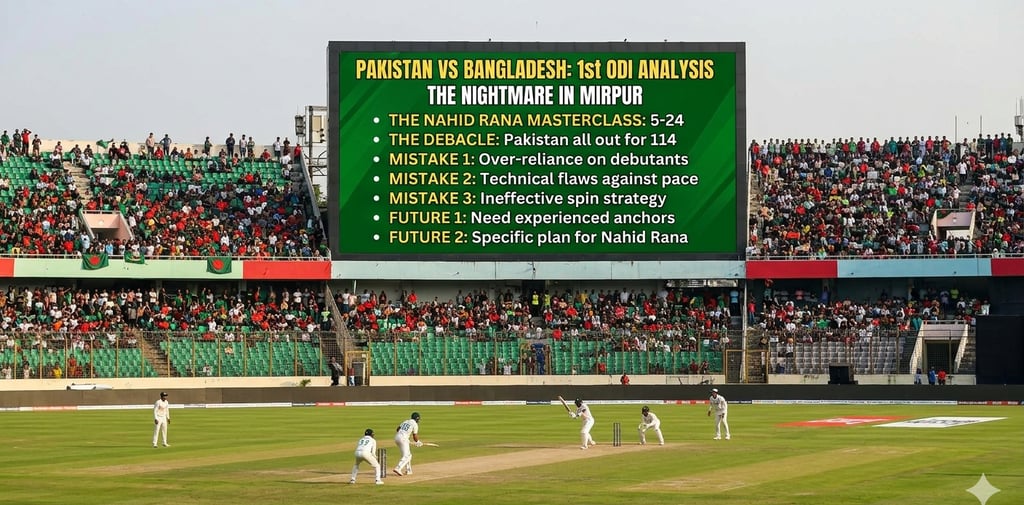
The first ODI between Pakistan and Bangladesh at the Shere Bangla National Stadium in Dhaka (March 11, 2026) was nothing short of a nightmare for the Green Shirts. After a disappointing T20 World Cup campaign, fans were hoping for a fresh start in the 50-over format. Instead, what they witnessed was a historic collapse and a dominant 8-wicket victory for the Tigers.
1. Match Overview: A Tale of Two Contrasting Performances
Bangladesh entered the series with a clear plan, winning the toss and electing to bowl on a surface that offered assistance to the pacers early on. Pakistan, fielding a "new-look" side with four debutants—Sahibzada Farhan, Maaz Sadaqat, Shamyl Hussain, and Abdul Samad—struggled to find any rhythm after a decent opening stand.
The Scorecard Summary
* Pakistan: 114 all out in 30.4 overs (Faheem Ashraf 37, Sahibzada Farhan 27; Nahid Rana 5-24).
* Bangladesh: 115/2 in 15.1 overs (Tanzid Hasan 67*, Najmul Hossain Shanto 27).
* Result: Bangladesh won by 8 wickets (Lead series 1-0).
2. In-Depth Analysis: Where Pakistan Lost the Game
The "Nahid Rana" Factor
The star of the show was undoubtedly Nahid Rana. The 23-year-old pacer produced a fiery spell of fast bowling that Pakistan’s top order simply could not handle. Rana became the first Bangladeshi bowler to dismiss the opposition’s top five batsmen in an ODI innings. His figures of 5-24 are now legendary in Mirpur.
The Batting Collapse
Pakistan’s innings can be divided into two parts: the first 10 overs and the chaos that followed.
* The Start: Farhan and Maaz provided a solid 41-run opening partnership. It looked like Pakistan was heading toward a competitive 250+ total.
* The Trigger: Once Farhan fell for 27, the floodgates opened. Pakistan went from 41-0 to 82-9.
* The Tail-end Resistance: Faheem Ashraf (37) was the only batter who showed some spine, pushing the total past 100 with a few lusty blows. Without his contribution, Pakistan might have been bundled out for under 80.
The Bowling Effort (or Lack Thereof)
Defending 114 requires early wickets and immense pressure. While Shaheen Shah Afridi removed Saif Hassan early, the rest of the attack looked toothless. Tanzid Hasan Tamim took the game away with a brutal 67* off 42 balls, smashing five sixes and rendering the Pakistani spinners ineffective on a pitch that usually favors them.
3. The "Mistake Ledger": Critical Errors Identified
To improve, one must first acknowledge the faults. Here are the primary reasons for today’s debacle:
A. Poor Shot Selection and Lack of Application
The debutants appeared over-eager. In ODI cricket, particularly in Dhaka, you need to "earn" the right to play big shots. Players like Shamyl Hussain and Abdul Samad (who got a duck) looked like they were still in T20 mode, trying to force the pace on a pitch that required consolidation.
B. Fragile Middle Order
The absence of experienced anchors in the middle order was glaring. Mohammad Rizwan (10) and Salman Agha (5) failed to provide the veteran leadership needed to stabilize the innings after the openers fell. A collapse of 9 wickets for roughly 40 runs is unacceptable at the international level.
C. Tactical Blunders in Bowling
Despite having a small total to defend, the bowling changes were predictable. Shaheen Afridi lacked his usual pace, and the introduction of spin was met with aggressive intent by Tanzid Hasan. Pakistan failed to create "dot ball pressure," allowing Bangladesh to reach the target in just 15 overs.
D. Psychological Hangover
The team looked like they were still reeling from their T20 World Cup exit. The body language was defensive, and there was a visible lack of communication on the field.
4. AdSense-Friendly Insights: Why This Matters for Fans
For digital creators and sports analysts, this match provides a goldmine of "High Value" topics. The rivalry between Pakistan and Bangladesh is evolving. Bangladesh is no longer an "underdog" at home; they are a powerhouse in Mirpur.
* Keyword Focus: Nahid Rana 5 wickets, Pakistan vs Bangladesh ODI 2026, Shaheen Afridi captaincy, Pakistan batting collapse analysis.
5. Future Suggestions: The Roadmap to Recovery
If Pakistan wants to avoid a series whitewash and rebuild for the 2027 World Cup, they must implement these changes immediately:
Short-Term Fixes (For the 2nd ODI)
* Reinstate Experience: While blooding youngsters is good, you cannot play four debutants in the same game in overseas conditions. Bringing back a seasoned middle-order batter is essential.
* Target Nahid Rana: The batters must develop a specific plan for Rana. Instead of trying to drive him on the up, they should look to play him late and use his pace to guide the ball.
* Spin Strategy: Abrar Ahmed and the other spinners must bowl more "attacking" lines. In low-scoring games, you don't defend runs; you hunt for wickets.
Long-Term Structural Changes
* Defined Roles: Players need to know their roles. Is Sahibzada Farhan a long-term opener or a middle-order floater? The "musical chairs" in the batting order must stop.
* Pitch Simulation: The PCB should develop "Dhaka-style" slow, turning tracks at the National Cricket Academy to prepare players for subcontinent tours.
* Mental Conditioning: The frequent collapses suggest a mental block rather than a lack of skill. Investing in a high-performance sports psychologist is no longer optional.
6. Conclusion: A Wake-Up Call
Today's defeat in Dhaka is a loud wake-up call. Bangladesh played like a team with a point to prove, while Pakistan played like a team searching for its identity. The 8-wicket loss is a stain on Pakistan's ODI record, but it is also an opportunity to prune the deadwood and rebuild.
The second ODI on Friday will be the ultimate test of character. Will Pakistan bounce back, or will the Tigers continue their dominance in Mirpur?
?
Contact
Questions or feedback? Reach out anytime.
© 2026. All rights reserved.