Pakistan T20 World Cup Journey (2007–2026): Full History, Records & Stats
Explore the complete history of Pakistan in T20 World Cups. From the 2009 victory at Lord's to Sahibzada Farhan's record-breaking 2026 campaign, discover all match results, squad details, and iconic moments of the Men in Green.
3/17/20264 min read
The Rollercoaster of the Green Shirts: A Comprehensive History of Pakistan’s T20 World Cup Journeys
In the volatile world of T20 cricket, no team embodies the spirit of "unpredictability" quite like the Pakistan national team. Known as the "Men in Green" or the "Cornered Tigers," Pakistan has a storied relationship with the ICC T20 World Cup. From the heartbreak of Johannesburg in 2007 to the ultimate glory at Lord’s in 2009, and the recent struggles of 2024, Pakistan’s journey is a saga of extreme highs and crushing lows.
As we look back at nearly two decades of T20 history, let’s dive deep into every chapter of Pakistan’s T20 World Cup story.
2007: The Heartbreak of Johannesburg
The inaugural 2007 World T20 in South Africa was where the world first realized that Pakistan was a natural fit for this shortest format. Under the captaincy of Shoaib Malik, a young and energetic Pakistani side took the tournament by storm.
The Journey:
Pakistan’s campaign began with a legendary tie against India, which led to the first-ever "bowl-out"—a moment that remains etched in history as Pakistan missed all three attempts while India hit theirs. Despite this, Pakistan surged through the Super 8s, defeating Australia and Sri Lanka.
The Final:
The final was a rematch against arch-rivals India. Chasing 158, Pakistan seemed down and out before Misbah-ul-Haq played a miraculous knock. With 6 runs needed off 4 balls and only one wicket left, Misbah attempted a scoop shot over short fine leg—only to find the hands of Sreesanth. Pakistan lost by 5 runs, a heartbreak that would define a generation but also set the stage for their future dominance.
2009: Redemption at the Home of Cricket
If 2007 was about what could have been, 2009 was about what had to be. In the backdrop of security challenges at home, Younis Khan led a team that felt it had a point to prove.
The Turning Point:
The tournament started poorly with a loss to England, but Pakistan found their rhythm in the Super 8s. The emergence of Shahid "Lala" Afridi as a top-order batter changed everything. His match-winning performances in the semi-final against South Africa (where he took 2 wickets and scored a fifty) propelled them to the final.
The Final:
Against Sri Lanka at Lord’s, Pakistan’s bowlers, led by Mohammad Amir and Abdul Razzaq, restricted the opposition to 138. Shahid Afridi then anchored the chase with a calm 54*, sealing an 8-wicket victory. As Younis Khan lifted the trophy, it wasn't just a win for the team; it was a gift to a nation in need of joy.
2010 & 2012: The Semi-Final Stumbles
Pakistan entered the next two editions as the most consistent T20 side in the world, reaching the semi-finals in both 2010 and 2012.
* 2010 (West Indies): Led by Shahid Afridi, Pakistan reached the semi-final against Australia. It looked like a certain win until Michael Hussey produced one of the most incredible cameos in history, hitting Saeed Ajmal for three sixes in the final over to snatch victory from the jaws of defeat.
* 2012 (Sri Lanka): Under Mohammad Hafeez, Pakistan once again cruised to the semis. However, they faltered on a slow Colombo pitch against the hosts, losing by 16 runs. This marked the end of Pakistan’s streak of reaching at least the semi-finals in every T20 World Cup.
2014 & 2016: The Era of Decline
The mid-2010s were a dark period for Pakistan in T20Is. The team struggled to adapt to the evolving power-hitting standards of the game.
* 2014 (Bangladesh): For the first time, Pakistan failed to reach the semi-finals. A crushing loss to the West Indies in a "do-or-die" group match saw them bundled out for just 82 runs.
* 2016 (India): A tournament plagued by off-field captaincy rumors and coaching changes. Pakistan won only one match (against Bangladesh) and suffered defeats to India, New Zealand, and Australia, leading to an early exit and a complete overhaul of the T20 setup.
2021: The Resurrection under Babar Azam
After a five-year hiatus between tournaments, Pakistan returned in 2021 with a new identity under Babar Azam.
The Historic Night:
October 24, 2021, changed Pakistan cricket history. In their opening match against India, Shaheen Shah Afridi’s opening spell dismantled the Indian top order. Babar Azam and Mohammad Rizwan سپس chased down 152 without losing a single wicket—Pakistan’s first-ever World Cup win against India.
The Heartbreak:
Pakistan finished the group stage undefeated (5-0). However, in the semi-final against Australia, a dropped catch by Hasan Ali in the penultimate over allowed Matthew Wade to hit three consecutive sixes off Shaheen, ending a near-perfect campaign in tears.
2022: The Miracle of Melbourne
The 2022 edition in Australia was a rollercoaster that only Pakistan could produce.
The Resurrection:
After losing heart-stoppers to India (thanks to a Virat Kohli masterclass) and Zimbabwe, Pakistan was on the verge of elimination. They needed a miracle. That miracle came when the Netherlands upset South Africa, opening the door for Pakistan to beat Bangladesh and sneak into the semis.
The Final:
They thrashed New Zealand in the semi-final to reach the MCG. In the final against England, Pakistan’s bowlers fought tooth and nail to defend a low total of 137. However, an injury to Shaheen Afridi at a crucial moment allowed Ben Stokes to guide England home. Pakistan finished as runners-up, a heroic effort after their disastrous start.
2024: The Low Point in the USA
The 2024 World Cup represented one of the most disappointing chapters in Pakistan’s history.
The USA Shock:
The campaign began with a stunning Super Over defeat to the tournament debutants and co-hosts, USA. This was followed by a narrow, agonizing loss to India in New York, where Pakistan failed to chase a modest 120. Despite wins against Canada and Ireland, the early losses meant Pakistan was eliminated in the group stage—their earliest exit in the history of the tournament.
2026: A New Dawn?
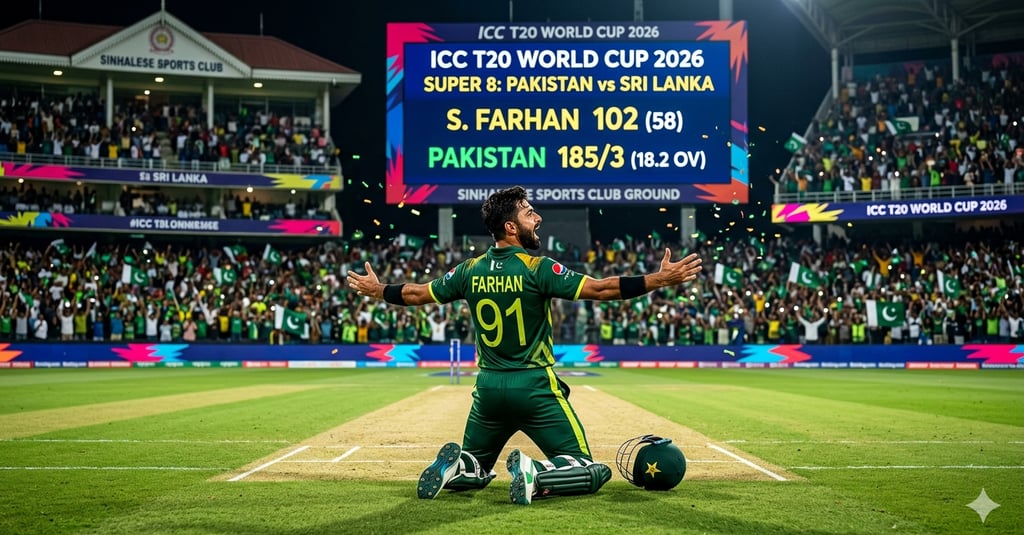
As we move into 2026, the Pakistan team is undergoing another transition. With new leadership and fresh talent like Sahibzada Farhan emerging—recently scoring a brilliant century in the 2026 edition—the cycle of hope begins again.
Summary of Performance (2007–2024)
| Year | Host | Result | Key Performer |
| 2007 | South Africa | Runners-up | Misbah-ul-Haq / Umar Gul |
| 2009 | England | Champions | Shahid Afridi / Umar Gul |
| 2010 | West Indies | Semi-Finalists | Salman Butt / Saeed Ajmal |
| 2012 | Sri Lanka | Semi-Finalists | Mohammad Hafeez / Saeed Ajmal |
| 2014 | Bangladesh | Group Stage | Ahmed Shehzad |
| 2016 | India | Group Stage | Mohammad Amir |
| 2021 | UAE/Oman | Semi-Finalists | Babar Azam / Rizwan / Shaheen |
| 2022 | Australia | Runners-up | Shadab Khan / Shaheen Afridi |
| 2024 | USA/WI | Group Stage | Babar Azam |
Conclusion
Pakistan's T20 World Cup history is a testament to the phrase "Cornered Tigers." They are a team that can lose to anyone on their worst day but can conquer the world on their best. Whether it is the magical swing of Wasim Akram’s successors or the clinical batting of the modern era, the Green Shirts remain the most captivating story in world criket.