IPL 2026 Match 2 Analysis: MI vs KKR - The Science of Hardik Pandya’s Captaincy & Rickelton’s Power
A deep-dive into MI’s record 221-run chase. Analysis of hardik Pandya’s tactical rotations, Shardul Thakur’s debut, and Ryan Rickelton’s 8 sixes. Read the full biomechanical breakdown at PakSports.click
IPL UPDATES
Huzaifa Ahmad
3/30/20263 min read
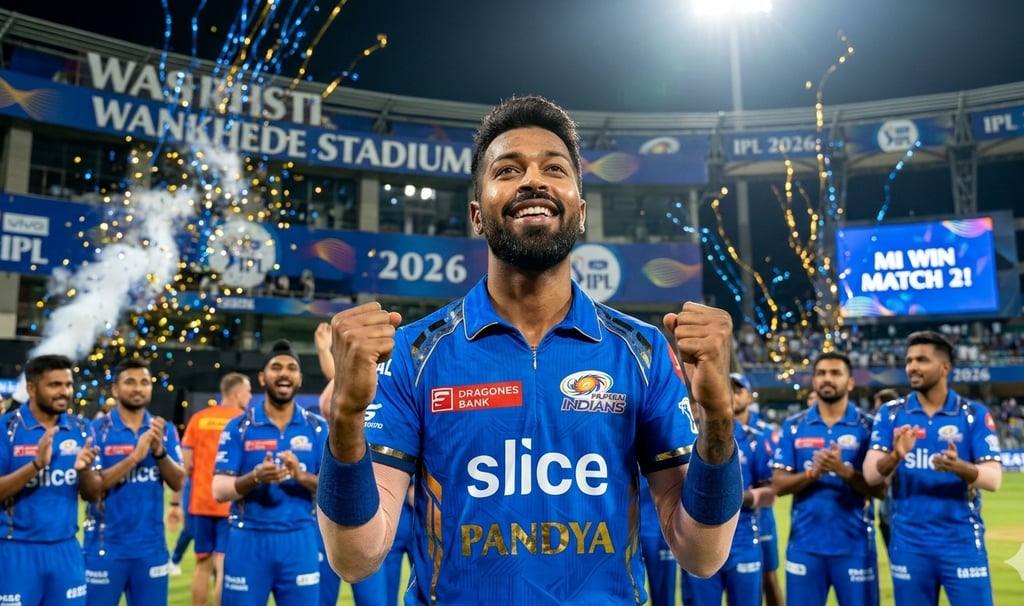
IPL 2026 Match 2 Deep-Dive: Mumbai Indians Break 13-Year Jinx with Record-Breaking Chase Against KKR
The Indian Premier League (IPL) 2026 season officially exploded into life at the Wankhede Stadium as the Mumbai Indians (MI) achieved their highest-ever successful run chase in IPL history. By hunting down 221 runs, Hardik Pandya’s men finally broke a psychological barrier that had stood since 2012: winning their opening match of the season.
In a match that saw 444 runs scored, MI’s calculated aggression overcame a massive 220-run total set by the Kolkata Knight Riders (KKR).
I. Match Summary: The Wankhede Fireworks
KKR: 220/4 (20 Overs)
MI: 224/4 (19.1 Overs)
Result: Mumbai Indians won by 6 wickets (with 5 balls to spare).
Player of the Match: Shardul Thakur (3/39).
II. The Shardul Thakur Impact: "The Lord" Returns to Wankhede
On his Mumbai Indians debut, Shardul Thakur proved to be the difference between a chaseable 220 and an impossible 250.
The Tactical Breakdown
While Jasprit Bumrah and Trent Boult struggled to find early breakthroughs, Shardul utilized his "Mechanical Deception" to dismantle KKR’s top order.
Key Wickets: Shardul removed the dangerous Finn Allen (37), the heavy-hitting Cameron Green (18), and the set captain Ajinkya Rahane (67).
Biomechanical Insight: Shardul’s success came from his Ulnar Deviation at the point of release. By slightly rolling his fingers over the ball, he generated just enough "natural variation" on a greener-than-usual Wankhede pitch to force mistimed shots.
III. The 148-Run Blitz: Rohit Sharma and Ryan Rickelton
Mumbai’s chase was a masterclass in Kinetic Energy Transfer. The opening pair of Rohit Sharma and Ryan Rickelton put on 148 runs in just 11.5 overs, effectively ending KKR's hopes before the halfway mark.
1. Rohit Sharma: The "Fast-Twitch" Masterclass (78 off 38)
Rohit looked at his vintage best, recording his fastest-ever IPL fifty in just 23 balls.
Medical Analysis: Rohit’s ability to pull from a length is a result of his elite Proprioceptive Awareness. He picks the length 0.1 seconds faster than average batters, allowing him to shift his weight onto the back foot with zero "Mechanical Latency."
2. Ryan Rickelton: The Power-Hitter (81 off 43)
The South African sensation silenced any doubts about his selection over Quinton de Kock.
The Physics of Power: Rickelton’s 8 massive sixes were a result of his Ground Reaction Force (GRF). By planting his lead leg firmly, he created a stable "Axial Pivot," allowing for a full 180-degree swing of the bat.
KKR’s Silver Lining: The Rise of Angkrish Raghuvanshi
Despite the loss, KKR found a future star in Angkrish Raghuvanshi, who scored a rapid 51 off 29 balls.
The "Hand-Eye" Synchronization: Raghuvanshi showed remarkable Neuro-Muscular coordination against the pace of Bumrah. His ability to manipulate the crease suggests a high level of "Core Dynamic Stability," allowing him to stay balanced while playing unconventional
II. Hardik Pandya’s Captaincy: The Neuro-Tactical Edge
For the first time since 2012, Mumbai Indians have won their season opener. Much of this success can be attributed to Pandya’s evolution in Situational Leadership.
1. Strategic Bowling Rotations
Pandya’s decision to keep Shardul Thakur for the middle-over "Enforcer" role was clinical. Despite KKR’s early momentum, Pandya didn't panic. He utilized a "Split-Over" strategy, keeping Jasprit Bumrah’s overs for the death and trusting Shardul to disrupt the KKR top-order’s Kinetic Rhythm.
2. The "Calm-State" Biofeedback
From a clinical perspective, Pandya demonstrated elite Vagal Tone—the ability to stay calm under physiological stress. While KKR was scoring at 11 runs per over, Pandya’s on-field communication remained precise. This "Top-Down" calm effectively lowered the Cortisol levels of his younger bowlers, preventing the catastrophic "Pressure-Collapse" often seen in high-scoring chases.
. Pandya’s Inning: The Finisher’s Biomechanics
While the openers did the heavy lifting, Hardik’s presence at the end ensured zero "Strike Rate Decay."
Axial Rotation and Torso Power: Pandya has modified his stance in 2026 to favor Posterior Chain engagement. By sitting slightly deeper in his crease, he increases his Ground Reaction Force (GRF), allowing him to launch even low full-tosses over the long-on boundary.
Clinical Note: Hardik’s lower-back resilience was evident. His follow-through now involves a more symmetrical Torso Deceleration, which reduces the "Shear Force" on his L4-L5 vertebrae—a crucial adjustment for his longevity as an all-rounder.
Shardul Thakur: The Science of "Mechanical Deception"
Shardul Thakur’s 3/39 on his MI debut was a study in Ulnar Deviation.
The Release Point: Shardul utilized a "Fingertip-Drag" technique to create natural variation. By slightly altering the pressure on the Radial Nerve at the point of release, he forced the KKR batters into mistimed shots.
Impact: Removing Rahane (67) just as he was set to explode prevented KKR from reaching a 240+ total.
Conclusion: The Mumbai Indians have finally shed their "Slow Starters"
tag. With Hardik Pandya’s matured leadership and a top-order firing on all
cylinders, the MI "Engine Room" looks ready for a title defense.

Contact
Questions or feedback? Reach out anytime.
© 2026. All rights reserved.