How Pakistan Can Defeat Bangladesh: 7 Critical Areas for Improvement
Discover the tactical changes Pakistan needs to dominate Bangladesh. From tackling spin to pace-bowling strategies, we analyze the blueprint for a Pakistan comeback.
MATCH ANALYSIS
3/12/20263 min read
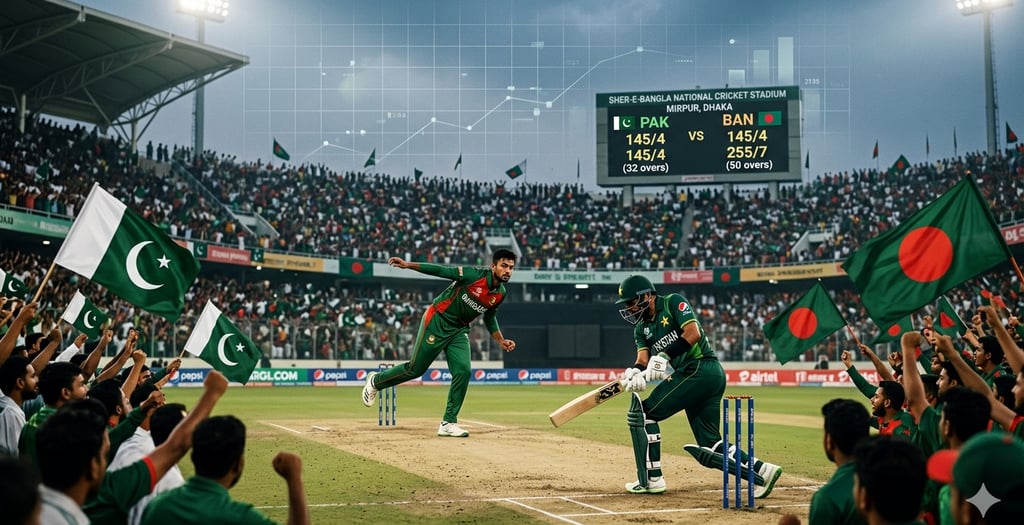
To defeat Bangladesh in the modern era, Pakistan must move past the era of "mercurial" labels and embrace a data-driven, tactically disciplined approach. Bangladesh is no longer the "minnow" of the 2000s; they are a formidable unit, especially at home in Mirpur or on sporting tracks where their pacers—like Nahid Rana and Taskin Ahmed—have recently dominated.
1. Technical Adaptation to Spin and Slow Tracks
Bangladesh’s greatest weapon has historically been the "slow and low" nature of their pitches. However, Pakistan’s recent struggles against spinners like Mehidy Hasan Miraz and Shakib Al Hasan suggest a decline in traditional subcontinental footwork.
* The Sweep Shot: Pakistani batters often get stuck on the crease. Incorporating the sweep and reverse-sweep is essential to disrupt the lengths of Bangladeshi spinners.
* Rotation of Strike: Against Bangladesh, the "dot ball pressure" is what leads to Pakistan's collapses. Improving the ability to find singles during the middle overs (overs 11–40 in ODIs) is non-negotiable.
* Neutralizing the Arm Ball: Many Pakistani right-handers fall prey to the ball that slides on. Better "late" playing and soft hands are required.
2. Rebuilding the Pace Battery’s Lethality
For decades, Pakistan’s pace was their trump card. Recent series, including the 2024 Test series loss to Bangladesh, showed a lack of bite in the fast-bowling department when the ball isn't swinging.
* Targeted Short-Ball Plans: Bangladesh’s top order has historically been vulnerable to high-quality, high-pace short pitching. Pakistan needs to use bowlers like Naseem Shah or Mohammad Hasnain to exploit this, rather than just bowling "line and length."
* Death Bowling Precision: Bangladesh has become adept at "scratched" wins by hitting boundaries in the final three overs. Pakistan must master the wide yorker and the slower bouncer to neutralize finishers like Towhid Hridoy or Jaker Ali.
3. Tactical Flexibility and Captaincy
The "rigid" approach to captaincy has cost Pakistan dearly. Bangladesh often uses "match-up" cricket (bringing on a specific bowler for a specific batter). Pakistan must counter this.
* Proactive Changes: Instead of waiting for a partnership to reach 50, the captain must be willing to introduce a "wildcard" bowler (like a part-time spinner) to break the rhythm.
* The "Intent" Factor: In T20s and ODIs, Pakistan’s "anchoring" approach often leaves them 20 runs short. Against a disciplined Bangladesh side, the opening pair must prioritize a high Strike Rate over average.
4. Mental Resilience and "Clutch" Performance
Former players often cite "mental fragility" as Pakistan’s biggest hurdle. In high-stakes moments against Bangladesh—like the 2025 Asia Cup narrow win or the 2024 Test upsets—Pakistan’s body language often drops the moment a wicket falls.
* Psychological Conditioning: The team needs to move away from the "fear of losing." This starts with a stable team selection policy so players don't feel their spot is at risk after one bad game.
* Handling the Dhaka Crowd: Playing in Mirpur is like playing in a pressure cooker. Pakistan needs specialized training to tune out the noise and maintain focus during the "crunch" 5-over periods.
5. Better Utilization of All-Rounders
One of Bangladesh’s secrets to success is their depth; they often bat deep down to number 8 or 9. Pakistan, conversely, often has a "long tail."
* Developing Bowling All-Rounders: Players like Aamir Jamal and Salman Ali Agha need to be groomed into consistent finishers. Having a number 8 who can clear the ropes is the difference between a total of 260 and 300.
* The Spin-Bowling All-Rounder: With the departure of veterans, Pakistan needs a reliable left-arm spinning all-rounder who can dry up runs, a role that Bangladesh excels at.
Comparison: Pakistan vs. Bangladesh (Recent Trends)
| Feature | Pakistan's Current Status | Bangladesh's Strength | Recommended Fix
| Powerplay Batting | Often cautious/slow | Aggressive with Litton/Tanzid | Use a "pinch hitter" or high-intent opener. |
| Middle-Order Spin | Struggle to rotate strike | Highly disciplined (Mehidy/Shakib) | Focus on sweep shots and 1s and 2s. |
| Pace Variety | Mostly high-pace/swing | Skilled in cutters/slower balls | Mastery of the "back-of-the-hand" slower ball. |
| Fielding | Inconsistent/Drops under pressure | Energetic and athletic | Specialized "pressure-catching" drills. |
6. Fielding: The Hidden Margin
In close games (like the 8-run loss in the 2025 T20I series), fielding is the differentiator. Pakistan must improve:
* Ground Fielding: Saving 10–15 runs in the circle can change the game's momentum.
* Direct Hits: Bangladesh's batters are quick runners; Pakistan must capitalize on half-chances at the non-striker’s end.
7. Strategic Scouting and Data Analytics
In 2026, cricket is played as much on iPads as it is on the field. Pakistan needs to invest in deeper scouting of Bangladesh's domestic stars.
* Nahid Rana's Pace: Pakistan was caught off guard by his bounce in 2024/25. Advanced video analysis can help batters prepare for specific release points.
* Exploiting Weak Zones: Data shows certain Bangladeshi batters struggle against leg-spin or left-arm angles. Pakistan must deploy these "match-ups" ruthlessly.
The Bottom Line
To defeat Bangladesh consistently, Pakistan must stop treating them as an "easy" opponent and start treating them as a tactical puzzle. By combining their natural flair with modern discipline, technical adaptation to spin, and a "never-say-die" mental approach, Pakistan can restore the hierarchy.

Contact
Questions or feedback? Reach out anytime.
© 2026. All rights reserved.