Eden Gardens Erruption: Finn Allen’s 33-Ball Blitz Shakes the World as Kiwis Crush Proteas
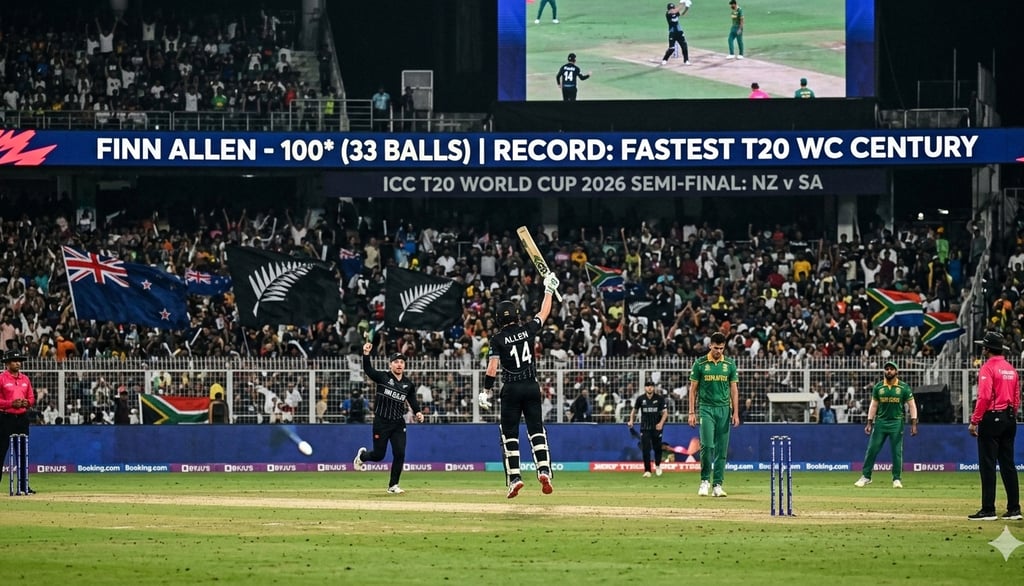
In a match that will be remembered as the "Kolkata Carnage," New Zealand's Finn Allen produced the greatest individual batting performance in T20 World Cup history to dismantle a previously unbeaten South African side. Chasing a competitive 170 for a spot in the final, Allen didn't just play an innings—he conducted a demolition.
MATCH UPDATES
3/4/20263 min read
The Kolkata Carnage: Finn Allen’s Historic Ton Propels New Zealand into the 2026 T20 World Cup Final
On a balmy evening at the iconic Eden Gardens in Kolkata, cricket fans witnessed a performance for the ages. The first semifinal of the 2026 ICC Men’s T20 World Cup between New Zealand and South Africa was billed as a clash of styles: South Africa’s unbeaten, methodical juggernaut versus New Zealand’s clinical, big-match temperament. What followed was not a contest, but a demolition.
In a display of sheer power-hitting that rewritten the record books, Finn Allen smashed a 33-ball century—the fastest in T20 World Cup history—to lead the Black Caps to a crushing nine-wicket victory. The win breaks a five-match losing streak for New Zealand against South Africa in T20 World Cups and secures their spot in the final against either India or England.
1. The Toss and the Early Ambush
Winning the toss proved to be Mitchell Santner’s first masterstroke. Recognizing that the Eden Gardens surface might offer early assistance to spin and variable bounce, he elected to bowl first.
New Zealand’s tactical flexibility was on display immediately. Instead of traditional pace from both ends, Santner turned to off-spinner Cole McConchie in the second over. The gamble paid dividends that arguably decided the match within ten minutes:
* Over 1.4: Quinton de Kock (10) mistimed a pull to mid-on.
* Over 1.5: Ryan Rickelton (0) was trapped LBW by a sliding delivery first ball.
South Africa, usually so composed, found themselves reeling at 12/2. The "Protea fire" was being dampened before it could even flicker.
2. South Africa’s Gritty Recovery
Aiden Markram (18) and the young Dewald Brevis (34) attempted to stabilize the ship with a 43-run partnership, but the New Zealand bowlers refused to let the run rate escalate. Rachin Ravindra was the thorn in South Africa’s side during the middle overs, dismissing Markram and the dangerous David Miller in quick succession.
When Brevis fell to Jimmy Neesham, South Africa were 77/5 in the 11th over. A sub-120 total looked imminent. However, Tristan Stubbs (29) and Marco Jansen (55*) staged a remarkable recovery.
* The Record Stand: Their 73-run partnership set a new South African record for the sixth wicket in T20Is.
* Jansen’s Late Charge: Marco Jansen used his massive reach to plunder 22 runs off Neesham’s 18th over. He reached his maiden T20I fifty in just 27 balls, eventually finishing with five sixes to propel South Africa to a "respectable" 169/8.
3. The Finn Allen Storm
If South Africa felt they had a competitive total, they were disabused of that notion within the first three overs of the chase. Finn Allen and Tim Seifert (58 off 33) came out with a clarity of intent that bordered on the transcendental.
The Powerplay Blitz
New Zealand raced to 84/0 in the first six overs—the second-highest Powerplay score in the tournament’s history. Allen was particularly brutal against Marco Jansen, the very man who had given South Africa hope with the bat. Jansen’s opening over went for 20 runs as Allen repeatedly cleared the front leg and launched him over long-on.
A Record-Breaking Century
Allen didn't just hit boundaries; he dismantled the South African psyche.
* The 50: Reached in a mere 19 balls (joint-fastest of the tournament).
* The 100: Secured with a boundary in the 13th over, taking just 33 balls.
The Final Stats: 100 runs, 10 fours, 8 sixes, and a staggering strike rate of 303.03.
By the time Tim Seifert fell to Kagiso Rabada in the 10th over, the score was already 117. The breakthrough was purely academic. Allen, supported by Rachin Ravindra, finished the game with 43 balls to spare.
4. Tactical Analysis: Why South Africa Collapsed
While Finn Allen’s brilliance was the headline, the match was lost in the tactical details:
* Failure to Adapt to Spin: South Africa’s top order struggled against McConchie and Ravindra, failing to use their feet or rotate strike, leading to the early collapse.
* Length Discipline: The South African pacers—Rabada, Ngidi, and Jansen—consistently bowled too full or too short. On a lightning-fast Kolkata outfield, Allen punished anything that wasn't a perfect yorker.
* The "Unbeaten" Curse: South Africa entered the game without a loss in the tournament. New Zealand, battle-hardened by a "scrappy" Super 8 campaign (as Harry Brook might say), seemed more prepared for the high-stakes pressure of a knockout.
5. Key Match Statistics
| Category | New Zealand | South Africa |
|---|---|---|
| Total Score | 173/1 (12.5 overs) | 169/8 (20 overs) |
| Top Scorer | Finn Allen (100*) | Marco Jansen (55*) |
| Best Bowler | Cole McConchie (2/9) | Kagiso Rabada (1/28) |
| Sixes Hit | 10 | 7 |
| Powerplay | 84/0 | 48/2 |
Conclusion: A Finalist Found
New Zealand has once again proven that they are the ultimate "tournament team." While they may not always have the most superstars, their ability to execute a specific plan—and their fearlessness in the Powerplay—has made them the first finalists of 2026.
For South Africa, the "chokers" tag will unfortunately resurface, though today was less a "choke" and more a case of being steamrolled by a generational individual performance. They were outplayed in all three departments by a team that simply refused to blink.

Contact
Questions or feedback? Reach out anytime.
© 2026. All rights reserved.